
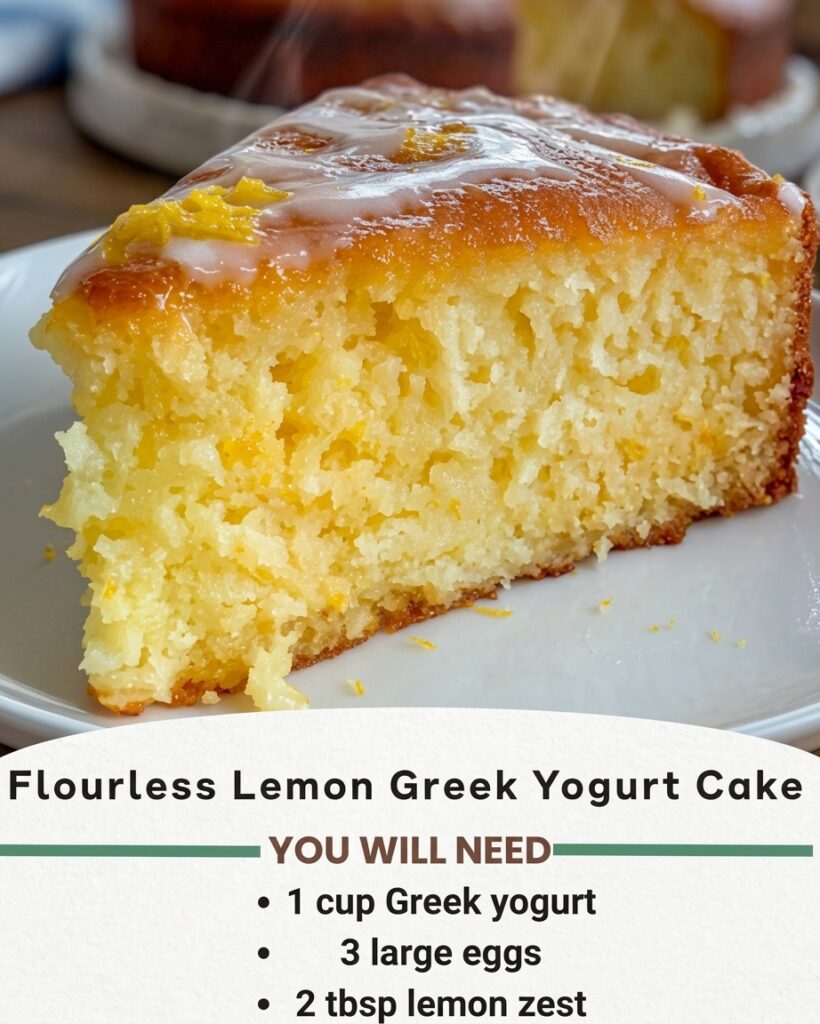

This tender flourless lemon cake is bright, creamy, and wonderfully soft, made with thick Greek yogurt, almond flour, and plenty of fresh lemon. Every bite has a delicate almond texture balanced by the refreshing tang of citrus, while Greek yogurt adds moisture and protein without making the cake heavy. It’s an easy high-protein dessert option when you want something comforting and satisfying with a lower-carb twist.
Can This Flourless Greek Yogurt Lemon Almond Cake Support Healthy Eating Goals?
This cake can fit into a balanced eating pattern when enjoyed as a dessert or snack alongside a varied diet. Greek yogurt and eggs provide protein, while almond flour contributes healthy fats and some fiber, which can make the dessert more satisfying than a traditional flour-based cake. Portion size still matters because it remains a dessert, but its protein-rich ingredients make it a more substantial choice than many conventional cakes.
Does This Flourless Greek Yogurt Lemon Almond Cake Fit a High-Protein Lifestyle?
Yes, this cake can be a protein-friendly dessert because it combines Greek yogurt and eggs with almond flour. The recipe contains fewer traditional flour-based carbohydrates, and its net carbs can be kept relatively moderate depending on the sweetener used. Greek yogurt contributes a creamy texture while increasing the protein content of each serving. For an even more protein-focused option, use strained Greek yogurt with a higher protein content.
Why This Recipe Is Special
- Flourless texture — Almond flour replaces traditional wheat flour for a tender, delicate crumb.
- Protein-friendly — Greek yogurt and eggs provide a useful protein boost for a dessert.
- Bright lemon flavor — Fresh lemon juice and zest give the cake a naturally refreshing taste.
- Lower-carb option — Almond flour keeps the recipe lower in carbohydrates than many conventional cakes.
- Simple ingredients — No complicated decorating or specialty baking techniques are required.
My Personal Experience
- The lemon flavor really stands out
Fresh lemon zest gives the cake a fragrant citrus aroma as it bakes.
The juice adds just enough tang to balance the creamy Greek yogurt. - The texture stays beautifully tender
Greek yogurt keeps the crumb soft without requiring a large amount of oil.
Almond flour gives it a slightly delicate, naturally nutty texture. - It feels satisfying for a dessert
The combination of yogurt, eggs, and almond flour makes each slice more substantial.
I like serving a modest slice when I want something sweet but not overly heavy. - It smells incredible while baking
The lemon zest and almond flour create a warm, bakery-style aroma in the kitchen.
The cake is especially inviting once the edges turn lightly golden.
Perfect For
- Weekend baking
- Afternoon tea or coffee
- Family dessert
- Lemon dessert lovers
- High-protein snack ideas
- Lower-carb dessert menus
- Spring and summer gatherings
- Make-ahead sweet treats
Why You’ll Love This Recipe
- No traditional flour required
Almond flour creates a tender cake without using regular wheat flour.
It also gives the finished dessert a subtle nutty flavor. - Fresh lemon flavor
Real lemon zest and juice make the cake taste bright rather than overly sweet.
The citrus pairs beautifully with the creamy yogurt base. - Soft and tender crumb
Greek yogurt adds moisture throughout the batter.
The result is delicate without being dry or crumbly. - Protein-friendly ingredients
Greek yogurt and eggs naturally increase the protein content.
That makes this a more substantial dessert choice than many basic cakes. - Easy to prepare
The batter comes together with simple mixing and no complicated technique.
It’s a great recipe for both beginner and experienced home bakers.
Common Mistakes to Avoid
- Using watery yogurt — Excess liquid can make the batter too loose and affect the final texture, so use thick Greek yogurt.
- Overmixing the batter — Mix just until the ingredients are combined to help maintain a tender crumb.
- Adding too much lemon juice — Extra liquid can change the batter consistency, so measure the juice accurately.
- Overbaking the cake — Remove it when the center is set and a toothpick comes out with a few moist crumbs rather than waiting for it to become completely dry.
Required Equipment
- 8-inch round cake pan — Provides the ideal depth for an evenly baked cake.
- Parchment paper — Helps release the delicate flourless cake cleanly.
- Mixing bowls — Keep the wet and dry ingredients easy to combine.
- Whisk — Smoothly incorporates the eggs, yogurt, and lemon.
- Rubber spatula — Folds the almond flour into the batter without overmixing.
- Fine grater/zester — Produces fragrant lemon zest without the bitter white pith.
Storage Instructions
Once completely cooled, store the cake in an airtight container in the refrigerator for up to 4 days. Because the recipe contains Greek yogurt and eggs, refrigeration is recommended for maintaining freshness and texture.
For longer storage, wrap individual slices tightly and freeze them in a freezer-safe container for up to 2 months. Thaw overnight in the refrigerator before serving.
The cake does not need reheating, but individual slices can be warmed gently in the microwave for about 10–15 seconds if you prefer a softer, slightly warm texture.
Recipe Details
Preparation Time: 15 minutes
Cooking Time: 35–40 minutes
Total Time: 50–55 minutes
Servings: 10 slices
Best Season: All-season
Calories Per Serving: Approximately 180 calories
Short Description
A tender flourless lemon cake made with Greek yogurt, almond flour, and fresh lemon.
Soft, bright, creamy, and naturally protein-friendly with a delicate almond flavor.
A simple lower-carb dessert for tea time, snacks, or special occasions.
📝 Ingredients
- 1 cup (240 g) plain Greek yogurt — use thick, unsweetened yogurt
- 3 large eggs
- 1 cup (100 g) fine almond flour
- ⅓ cup (65 g) granulated sweetener — use your preferred baking-friendly option
- 2 tablespoons fresh lemon juice
- 1 tablespoon finely grated lemon zest
- 1 teaspoon vanilla extract
- 1 teaspoon baking powder
- ¼ teaspoon baking soda
- ¼ teaspoon salt
- 1 tablespoon melted unsalted butter or neutral oil — for a slightly richer crumb
Optional: Dust with a small amount of powdered sweetener or garnish with thin lemon slices before serving.
Directions
- Preheat the oven: Set the oven to 350°F (175°C). Grease an 8-inch round cake pan and line the bottom with parchment paper.
- Prepare the wet ingredients: In a large bowl, whisk the Greek yogurt, eggs, sweetener, lemon juice, lemon zest, vanilla, and melted butter until smooth and evenly combined.
- Combine the dry ingredients: In a separate bowl, whisk together the almond flour, baking powder, baking soda, and salt.
- Make the batter: Gradually add the dry ingredients to the yogurt mixture. Stir gently with a spatula just until no dry streaks remain. Avoid overmixing.
- Transfer to the pan: Pour the batter into the prepared pan and smooth the surface. The batter should be thick but easily spreadable.
- Bake: Place the cake on the center rack and bake at 350°F (175°C) for 35–40 minutes. The edges should look lightly golden, and the center should be set with a slight softness.
- Check for doneness: Insert a toothpick into the center. It should come out clean or with a few moist crumbs attached.
- Cool: Let the cake cool in the pan for approximately 10–15 minutes, then transfer it to a rack and allow it to cool completely before slicing.
- High-protein tip: Choose a thick Greek yogurt with a higher protein content to naturally increase the protein contribution while maintaining the cake’s moist texture.
- Serve: Slice gently and serve plain, with a little Greek yogurt, or with fresh berries for extra freshness.
Nutrition Facts — Per Serving, Approximate
Values are estimates and can vary depending on the exact Greek yogurt, sweetener, almond flour, and portion size used.
- Calories: ~180 kcal
- Fats: ~11 g
- Cholesterol: ~70 mg
- Sodium: ~150 mg
- Potassium: ~120 mg
- Total Carbohydrates: ~9 g
- Fiber: ~2 g
- Net Carbs: ~7 g
- Sugars: ~3 g
- Protein: ~8 g
- Calcium: ~80 mg
Notes
- Storage: Refrigerate in an airtight container for up to 4 days.
- Freezing: Freeze individual wrapped slices for up to 2 months.
- Reheating: Warm a slice for 10–15 seconds in the microwave if desired.
- Allergy note: This recipe contains almonds, eggs, and dairy.
- Lemon boost: Add a little extra zest for a stronger citrus aroma without substantially changing the batter consistency.
- Texture: Allow the cake to cool completely before slicing because the crumb firms as it cools.
- Serving idea: Top with a spoonful of Greek yogurt and fresh berries for an extra creamy and colorful presentation.
Frequently Asked Questions
1. Can I make this cake without almond flour?
Almond flour is important to the recipe’s texture, so substituting it with another flour may require adjusting the liquid and baking time.
2. Can I use regular yogurt instead of Greek yogurt?
Yes, but thicker Greek yogurt is preferred because it produces a creamier batter and contributes more protein.
3. How do I get a stronger lemon flavor?
Increase the finely grated lemon zest slightly rather than adding a large amount of extra lemon juice.
4. Why is my flourless cake slightly soft in the center?
A little tenderness is normal, but if the center looks wet or unset, bake it for a few additional minutes.
5. Can I freeze this lemon cake?
Yes, individual slices can be wrapped well and frozen for up to about 2 months.
6. Is this cake suitable as a high-protein snack?
It can fit a protein-conscious snack pattern, particularly when served with additional Greek yogurt or another protein-rich accompaniment.