
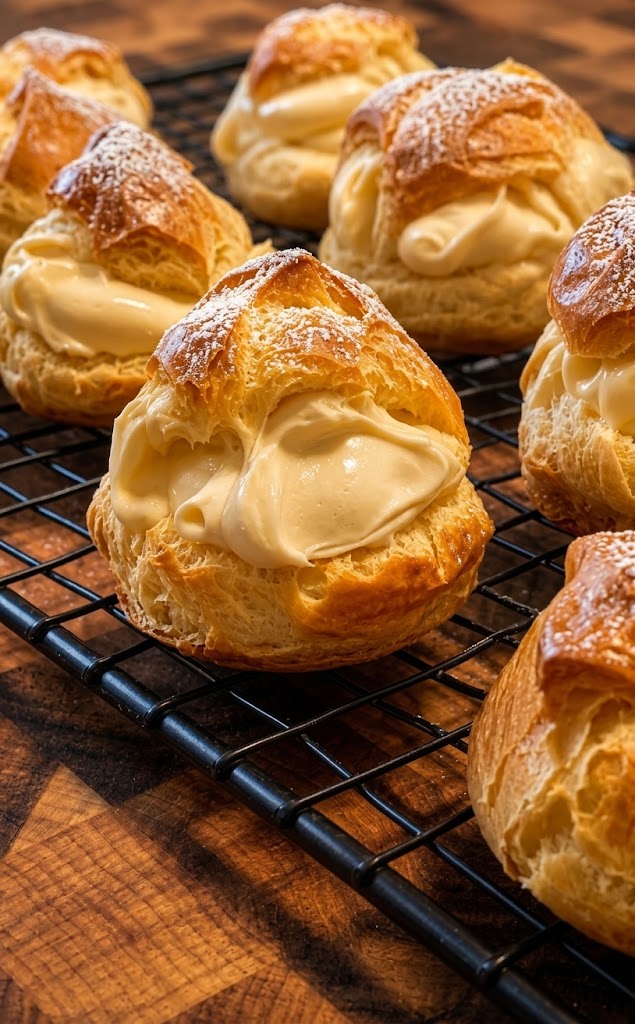

Description
Classic French Cream Puffs are delicate, golden pastries made with light and airy pâte à choux and filled with silky homemade vanilla pastry cream. Their crisp outside, hollow center, and rich creamy filling create an irresistible contrast in every bite. While traditional cream puffs aren’t naturally a high-protein or low-carb dessert, this recipe can still fit into a balanced eating plan when enjoyed in moderation.
Can This Classic French Cream Puffs Recipe Support Weight Loss Goals?
Classic French Cream Puffs are a dessert rather than a specifically weight-loss-focused food. They contain butter, flour, sugar, eggs, and pastry cream, so portion size is important when managing overall calorie intake. The eggs and milk provide some protein, which can contribute to satiety, but this recipe is not a high-protein or low-carb recipe in its traditional form. Enjoying one appropriately sized cream puff as part of a balanced diet can be a reasonable approach.
Does Classic French Cream Puffs Fit a High-Protein Lifestyle?
Traditional French Cream Puffs are not considered high-protein because flour, butter, and sugar make up much of the recipe. The eggs and whole milk contribute protein, while the pastry cream adds additional protein from egg yolks and milk. Net carbs are relatively high because the choux pastry contains all-purpose flour and sugar. If you’re following a high-protein lifestyle, treat these as an occasional dessert alongside protein-rich meals rather than as a primary protein source.
Why This Recipe Is Special
- Classic French technique: Uses traditional pâte à choux for beautifully puffed pastry.
- Light and airy: The hollow centers are perfect for generous amounts of creamy filling.
- Comforting dessert: Vanilla pastry cream gives every bite a rich, nostalgic flavor.
- Elegant but approachable: It looks bakery-worthy without requiring complicated equipment.
- Make-ahead friendly: The pastry cream and shells can be prepared separately in advance.
My Personal Experience
- The pastry puffs beautifully:
I love watching the small rounds transform into golden, airy shells in the oven.
The crisp exterior and hollow middle make them especially satisfying to fill. - The vanilla pastry cream is the highlight:
The creamy filling adds a smooth, rich contrast to the light choux pastry.
A generous amount of vanilla makes the finished cream puffs taste wonderfully homemade. - They’re surprisingly elegant:
A simple dusting of powdered sugar makes these look like something from a French bakery.
They’re especially impressive when served on a dessert platter. - The texture makes them memorable:
Freshly baked shells have a delicate crispness that contrasts beautifully with the soft filling.
For the best experience, I recommend filling them shortly before serving.
Perfect For
These Classic French Cream Puffs are perfect for afternoon tea, dinner parties, birthdays, holidays, bridal or baby showers, dessert tables, and weekend baking projects. They’re also a lovely choice when you want an elegant homemade dessert for guests. For meal-prep-style planning, the unfilled shells and pastry cream can be prepared separately and assembled closer to serving time.
Why You’ll Love This Recipe
- Crisp outside, creamy inside:
Golden pâte à choux surrounds a smooth vanilla pastry cream.
The contrast in textures makes every bite delicious. - Classic French flavor:
Simple ingredients allow the buttery pastry and vanilla cream to shine.
There’s no need for complicated flavoring or elaborate decoration. - Beautiful presentation:
A light dusting of powdered sugar gives these cream puffs an elegant finish.
They look special enough for celebrations while remaining easy to serve. - Great make-ahead components:
The pastry cream can be chilled ahead of time, while the shells can be baked separately.
Simply fill and finish them shortly before serving.
Common Mistakes to Avoid
- Adding too much egg: This can make the choux dough too loose, causing the puffs to spread instead of rising.
- Opening the oven too early: A sudden temperature change can cause underbaked shells to collapse.
- Underbaking the shells: Pale or soft shells usually contain too much moisture and may deflate after cooling.
- Filling warm pastries: Always cool the shells completely before adding pastry cream to prevent melting and sogginess.
Required Equipment
- Medium saucepan — provides even heat for preparing both the choux dough and pastry cream.
- Large mixing bowl — gives enough room to incorporate the eggs smoothly.
- Whisk — creates a smooth, lump-free pastry cream.
- Wooden spoon or sturdy spatula — makes stirring the thick choux dough easier.
- Piping bag — helps create evenly sized cream puff shells and neatly filled centers.
- Large round piping tip — produces consistent pastry shapes.
- Baking sheet — provides a flat surface for even baking.
- Parchment paper — prevents the pastry shells from sticking.
- Wire rack — allows the shells to cool without trapping excess steam.
Storage Instructions
Unfilled cream puff shells: Store completely cooled shells in an airtight container at room temperature for up to 2 days.
Pastry cream: Keep refrigerated in an airtight container with plastic wrap pressed directly against the surface for up to 2 days.
Filled cream puffs: Refrigerate in a covered container and enjoy preferably within 24 hours. The filling gradually softens the pastry.
Freezer: Unfilled baked shells can be frozen in an airtight freezer-safe container for up to 2 months. Thaw at room temperature and crisp briefly in a low oven before filling.
For a protein-conscious eating plan, store the pastry cream separately and portion the finished dessert rather than keeping a large batch filled.
Recipe Details
Preparation Time: 30 minutes
Chilling Time: 1–2 hours
Cooking Time: 30–35 minutes
Total Time: About 2½ hours
Servings: 20 cream puffs
Best Season: All-season
Total Calories: Approximately 185 calories per serving
Short Description
Light French pastry shells are baked until golden and airy.
They’re filled with smooth homemade vanilla pastry cream.
A dusting of powdered sugar gives them a simple, elegant finish.
📝 Ingredients
For the Choux Pastry
- 1 cup (240 ml) water
- ½ cup (113 g) unsalted butter, cut into pieces
- 1 tablespoon granulated sugar
- ¼ teaspoon salt
- 1 cup (125 g) all-purpose flour, sifted
- 4 large eggs, room temperature
- 1 teaspoon vanilla extract
Note: Add the eggs gradually. Depending on their size and the dough consistency, you may not need to use every bit of the final egg.
For the Vanilla Pastry Cream
- 2 cups (480 ml) whole milk
- ½ cup (100 g) granulated sugar, divided
- 4 large egg yolks
- ¼ cup (30 g) cornstarch
- 2 tablespoons (28 g) unsalted butter
- 1½ teaspoons vanilla extract
- Pinch of salt
For Finishing
- 2–3 tablespoons powdered sugar, for dusting
Directions
1. Prepare the pastry cream
Pour the whole milk into a medium saucepan and heat over medium heat until steaming. Do not allow it to boil vigorously.
In a bowl, whisk the egg yolks, half of the sugar, cornstarch, and salt until smooth and pale.
2. Temper the eggs
Slowly whisk about half of the hot milk into the egg mixture.
Pour everything back into the saucepan and return to medium heat.
Whisk continuously for about 2–4 minutes, until the mixture becomes noticeably thick and creamy.
Texture cue: The pastry cream should coat the whisk and hold its shape briefly when stirred.
3. Finish the pastry cream
Remove from the heat and whisk in the butter and vanilla.
Transfer to a bowl and press plastic wrap directly against the surface.
Refrigerate for 1–2 hours, or until completely chilled.
High-protein tip: The milk and egg yolks provide protein, but avoid reducing the amount of eggs or milk substantially because they contribute to the pastry cream’s structure.
4. Prepare the choux dough
Preheat the oven to 425°F (220°C).
Line a baking sheet with parchment paper.
Add water, butter, sugar, and salt to a saucepan and bring to a gentle boil over medium heat.
5. Add the flour
Remove the saucepan from the heat and add all the flour at once.
Stir vigorously until a smooth dough forms.
Return the pan to medium-low heat and cook for 1–2 minutes, stirring continuously.
Visual cue: The dough should pull away from the sides of the pan and form a smooth ball.
6. Add the eggs
Transfer the dough to a mixing bowl and let it cool for approximately 5 minutes.
Add the eggs one at a time, mixing thoroughly after each addition.
Add the vanilla.
Texture cue: The finished dough should be smooth, glossy, thick, and pipeable. It should hold its shape rather than flow like batter.
7. Pipe the cream puffs
Transfer the dough to a piping bag fitted with a large round tip.
Pipe approximately 20 small mounds, leaving about 2 inches (5 cm) between them.
If small peaks remain on top, gently smooth them with a damp fingertip.
8. Bake
Bake at 425°F (220°C) for 15 minutes.
Without opening the oven door, reduce the temperature to 375°F (190°C).
Continue baking for 15–20 minutes, until the shells are deeply golden and firm.
High-protein cooking tip: Don’t shorten the baking time to save calories or moisture—the eggs provide structure, but the pastry still needs sufficient baking to dry properly.
9. Dry the shells
Turn off the oven and crack the door open slightly.
Leave the cream puffs inside for 10 minutes.
Transfer them to a wire rack and cool completely.
10. Fill the cream puffs
Whisk the chilled pastry cream briefly until smooth.
Transfer it to a piping bag.
Make a small hole in the bottom of each cream puff and pipe in the pastry cream.
Alternatively, cut each shell horizontally and spoon or pipe the cream inside.
11. Finish and serve
Dust the filled cream puffs lightly with powdered sugar.
Serve immediately for the best contrast between the delicate pastry and creamy filling.
Nutrition Facts
Per Serving — Approximate
- Calories: 185 kcal
- Fat: 10 g
- Cholesterol: 100 mg
- Sodium: 115 mg
- Potassium: 80 mg
- Total Carbohydrates: 19 g
- Fiber: 0.5 g
- Net Carbs: 18.5 g
- Sugars: 9 g
- Protein: 4 g
- Calcium: 55 mg
Nutrition note: Values are approximate and can vary depending on ingredient brands, pastry size, and the amount of filling used.
Notes
- Storage: Keep filled cream puffs refrigerated and enjoy within about 24 hours for the best texture.
- Reheating: Don’t microwave filled cream puffs. For unfilled shells, warm them in a 300°F (150°C) oven for 5–8 minutes and cool before filling.
- Allergy notes: Contains wheat, eggs, and dairy. Use suitable alternatives only if you’re comfortable adjusting the traditional recipe.
- Flavor boost: Add extra vanilla, a small amount of finely grated orange zest, or a light chocolate drizzle for a different finish.
- Best texture: Fill the shells shortly before serving so they retain as much crispness as possible.
- Protein note: This is a traditional dessert, not a high-protein recipe. Pairing a modest portion with a protein-rich meal or snack can help it fit more comfortably into a high-protein lifestyle.
Frequently Asked Questions
1. Why did my French cream puffs collapse?
They may be underbaked or contain excess moisture, so bake until deeply golden and firm.
2. Can I make the pastry cream ahead of time?
Yes, the pastry cream can be refrigerated in an airtight container for up to 2 days.
3. Can I freeze French cream puff shells?
Yes, unfilled baked shells can be frozen for up to about 2 months.
4. Can I use whipped cream instead of pastry cream?
Yes, lightly sweetened whipped cream is an easy alternative, although vanilla pastry cream gives a richer traditional filling.
5. Why aren’t my cream puffs hollow inside?
The dough may contain too much moisture or the flour mixture may not have been cooked sufficiently before the eggs were added.
6. How far in advance should I fill the cream puffs?
For the best texture, fill them shortly before serving, ideally within a few hours.